La tétine Clipp
17.05.2026
What is the Clipp® dummy and how does it work?

The Clipp® weaning dummy is fitted with a system for gradual weaning that respects the child’s own pace. It is CE-certified and Bisphenol-A (BPA)-free, and designed to support a gentle weaning process. It is recommended from the age of 2.
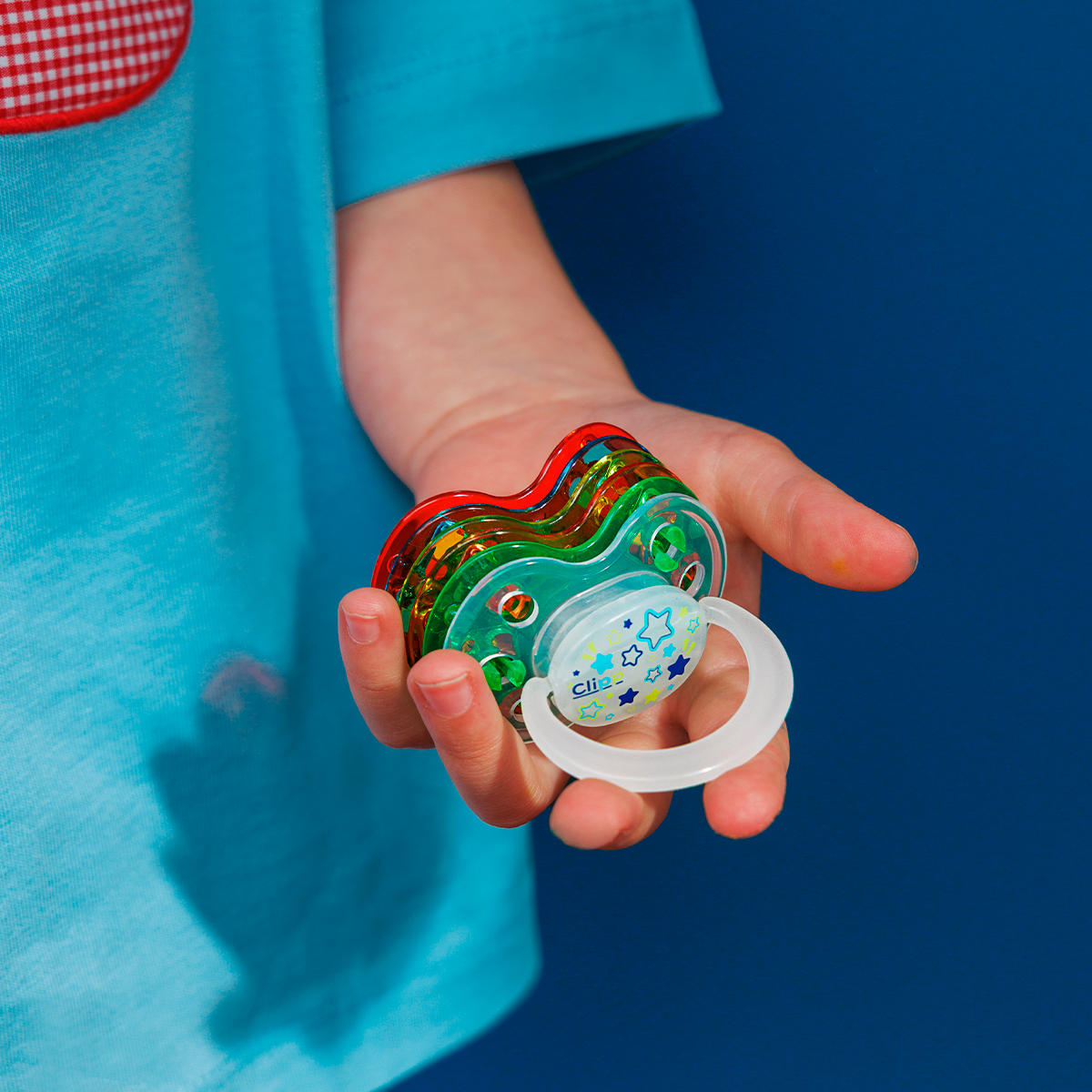
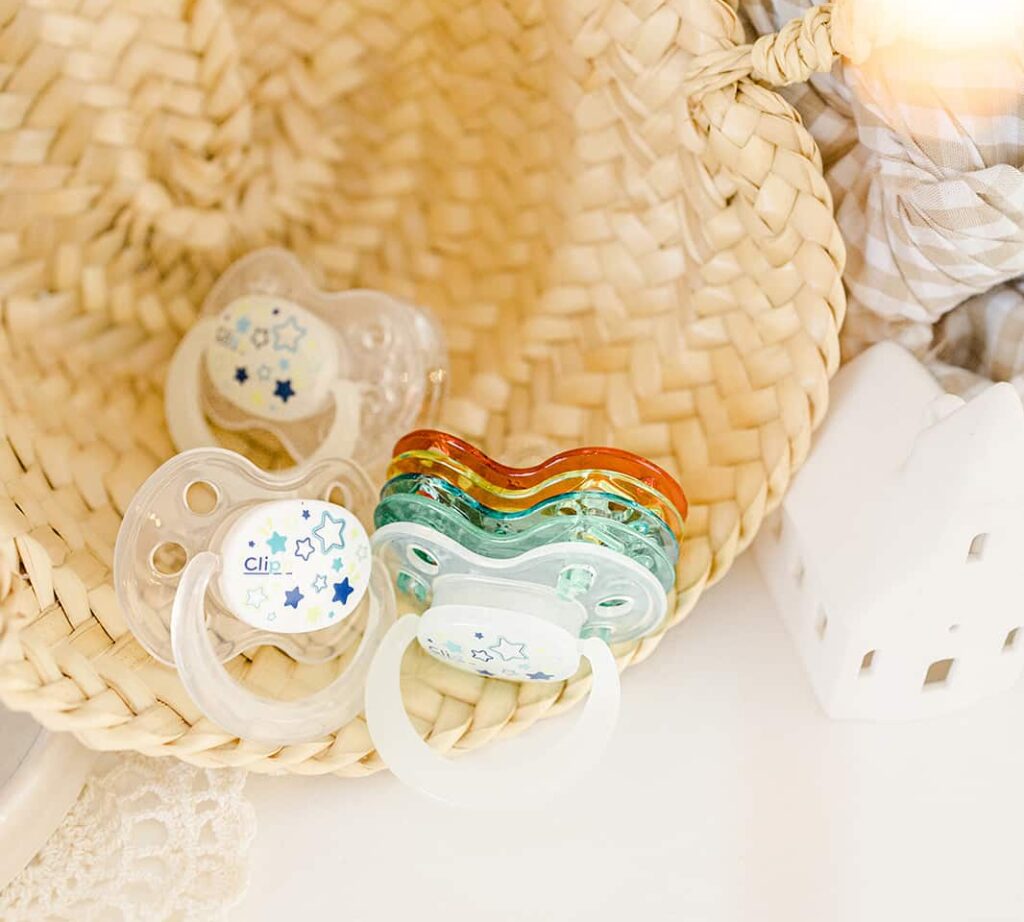
Clipp is a dummy that has been specially designed to make weaning easier. It features five stackable shields, which gradually reduce the size of the sucking teat. The Clipp kit includes:
Clipp is the result of seven years of research and development. It was designed by Arnaud and Virginie, parents, co-founders of Clipp and orthodontic professionals. After several prototypes and tests, Clipp was patented in 2024.
Here’s how it works:
The shields have a patented locking system designed so that, once fitted, they cannot be removed, and so cannot be taken off by the child. Weaning with Clipp generally takes about 4 weeks*. This period can be adjusted to the child’s reaction and comfort: parents can adapt the rate at which the shields are added. If your child gets stuck at the 4th or 5th “clip”, find out how to help. To find out whether the shields fit another dummy, read Do the “5 Clipp” fit with other dummies?
The British Orthodontic Society notes that the length of time the habit lasts matters more than how hard the child sucks [1]. A common reference is to start limiting dummy use from around 6 to 12 months of age and to stop between 2 and 3 years old. The longer the habit continues, the more likely it is to affect the teeth. To find out more, see The impact of dummies on health and When should you stop the dummy? Age, signs and the right time for weaning.
In the pilot study carried out at Nice University Hospital, 38 children had an open bite (where the front teeth no longer meet) at the start. In 34 of them (89.5%), it had reduced or corrected by the end of weaning [2]. This study had no control group: it gives an encouraging signal, not definitive proof.
Psychologically, Clipp lets the child keep their familiar, comforting item during weaning. Weaning is gradual and the child stays actively involved in stopping, which can strengthen their sense of security, independence and self-confidence. The British Orthodontic Society advises a positive approach: stay positive and avoid nagging, teasing or punishing the child [1].
The Clipp kit is designed to make weaning off the dummy fun and educational. As well as the dummy and shields, it includes detailed instructions for use. The calendar and the reward certificate are in the Clipp ritual, which you can download from our shop.
The calendar lets families follow weaning progress and plan when to add shields. Each day, the child can tick a box or stick on a sticker, and so see how far they have come towards giving up the dummy. The reward certificate is an extra incentive: at the end of weaning, the child can receive a certificate celebrating their success, marking an important stage in their development and boosting their pride. Find all the details in our article on the Clipp ritual.
More than 5,000 healthcare professionals recommend Clipp to their patients. They appreciate its gradual approach, which respects the child’s pace.
Clipp has also won several awards: in 2023, the silver medal at the Concours Lépine international inventors’ competition, the 3rd Fidéalis prize and the Mam’Advisor 2024 editorial prize. It was also assessed in a pilot study at Nice University Hospital (dental surgery thesis, Université Côte d’Azur, 2025), with 62 children aged 2 years to 7 years and 10 months: of the 54 children who completed the follow-up, 51 stopped using their dummy (94.4%), after 46 days on average (from 2 to 138 days) [2].
Clipp has already supported more than 100,000 children. Many parents have shared their experience. Marie, Léon’s mum, tells us how her son gradually stopped using a dummy thanks to the Clipp shields: “Léon was a bit sceptical at first, but quickly accepted the system. Every week, we added a new shield, and he saw it as a game. After a month, he had completely stopped sucking his dummy. It was incredible to see how smooth the process was.”
Another parent, Julien, explains: “My daughter Emma found it really hard to part with her dummy. With Clipp, she was able to do it at her own pace, without crying or stress. The fun calendar really helped her to visualise her progress. I’d recommend Clipp to all parents looking for a gentle weaning solution.”
Read all the parents’ testimonials!
Does your child have a round dummy? Here’s what to do.
And if you’re wondering whether you need several Clipp dummies, the answer is here.
Clipp is made in France, with particular attention paid to quality and safety. The shields and packaging are produced locally, while the dummy itself is produced by a French ESAT (establishment supporting people with disabilities in the workplace) in Chartres. An approach that reflects our desire to support the local economy.
Clipp supports the move away from the dummy, but it does not replace medical advice. Talk to your dentist, orthodontist, paediatrician or speech and language therapist if you have any doubts or if your child still has a dummy at 4 or 5 years old.
Ready to get started? Discover the Clipp® weaning dummy.
* Every child is different, and weaning can take longer. In the pilot study at Nice UniversityHospital, the average length of weaning was 46 days (from 2 to 138 days) [2].
Sources :