
Arrêter la tétine
18.05.2026
When should you stop the dummy? Age, signs and the right time for weaning

When should you stop the dummy? It’s one of the most common questions parents ask, and the answer comes down to a reference: start limiting use from around 6 to 12 months of age, and stop completely between 2 and 3 years old. Here are the age references, the signs that show your child is ready, the best moments to choose or avoid, and when to ask a professional for advice.
During the first year, a dummy is generally accepted. From around 6 to 12 months, you can start limiting its use. Between 2 and 3 years, there is still time to organise weaning with your child’s involvement, aiming to stop by around 3 years old. After that, it’s better not to wait any longer: at 4 or 5, stopping becomes particularly important, with the help of a professional if needed. For an older child, see our article on stopping the dummy after age 4.

The British Orthodontic Society advises staying positive and building their self-esteem [1].
It’s better to wait if your child is going through:
Very heavy crying or persistent sleep problems are also a reason to take it slower. Postponing for a few weeks isn’t a problem, as long as you set a new date. On the other hand, some professionals warn that stopping a dummy too early, or by force, can push a child towards thumb sucking, which is often harder to stop.

Choose a positive landmark that marks a step towards more independence: a birthday, the start of the school year, a holiday, Christmas, a positive change of routine, a visit to the dentist, or a time when your child is already using their dummy less.
Yes, it’s better not to wait any longer in these situations:

Some early dental changes can improve after the habit stops, but the longer it lasts, the less likely this is, and the more likely it is to affect the teeth [1]. Some professionals also note that long-lasting sucking habits may, in some cases, affect jaw growth and functions such as breathing and swallowing. Stopping in time may reduce the need for orthodontic treatment later.
Once the right moment has been identified, the method matters as much as the date. Gradual, positive weaning works better than pressure or criticism, which can create a power struggle and prolong the habit. Rules to set, goodbye rituals, stories, rewards, tears: it’s all explained in how to stop your child’s dummy use gently.
Before 2, gradual weaning is still possible by cutting down the times of use little by little.
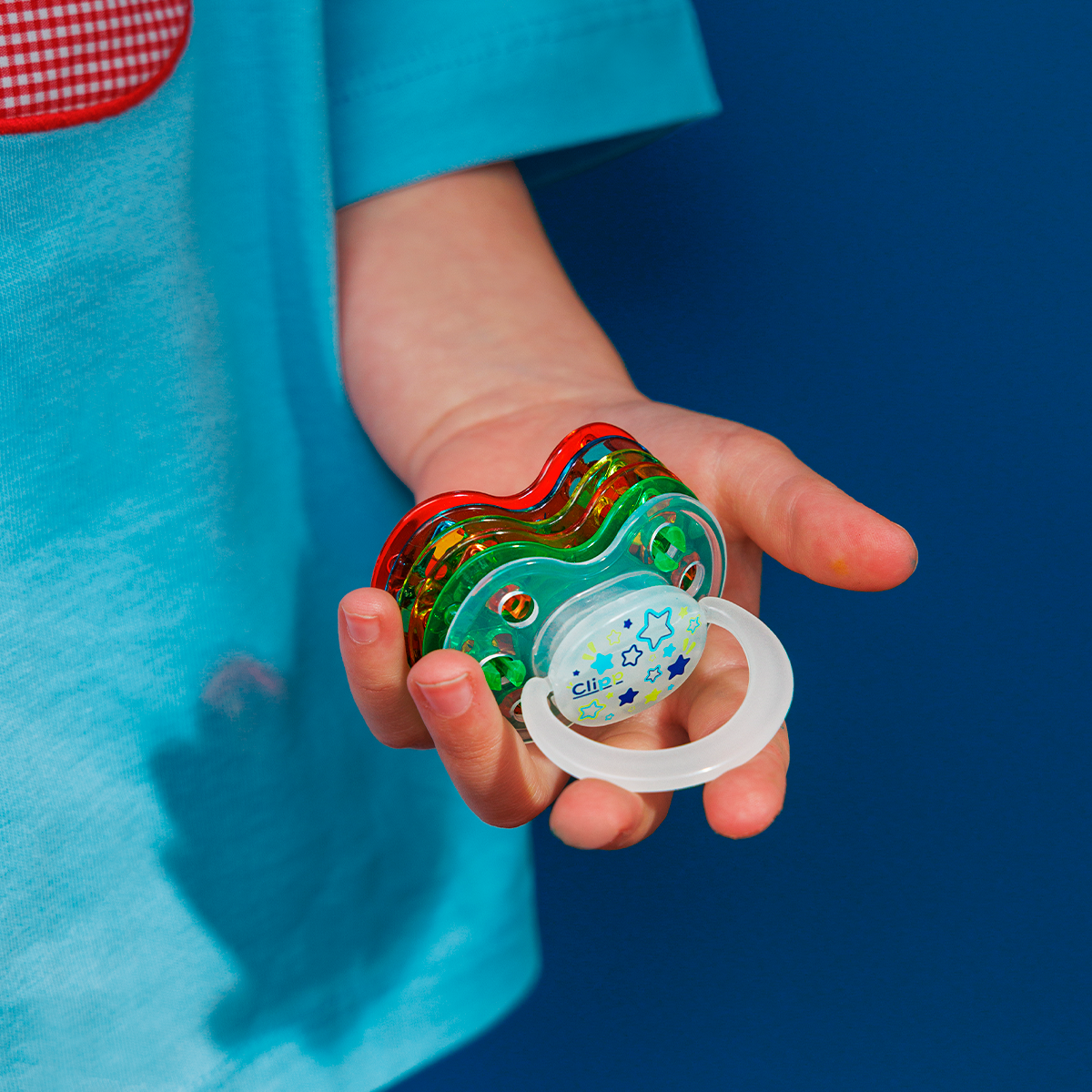
Clipp is recommended from 2 years old. The Clipp weaning dummy offers gradual weaning in about 4 weeks*: after 2 days of adjustment without a shield, a shield is added each week, up to the fifth. Your child keeps their comfort item, with no abrupt removal, and the Dummy Weaning Toolkit helps them follow and celebrate each step.
Clipp was assessed in a pilot study at Nice University Hospital (dental surgery thesis, Université Côte d’Azur, 2025), with children aged 2 years to 7 years and 10 months. Among the 54 children who completed the follow-up, 51 stopped using their dummy (94.4%) [2].
Clipp has already supported more than 100,000 children and is recommended by more than 5,000 health professionals.
Talk to your dentist, orthodontist, GP, health visitor or speech and language therapist if your child still has their dummy at around 4 or 5, if weaning causes significant distress, if they can’t cut down their use, if dental changes are visible, if speech, breathing or ENT problems are involved, or if you’re unsure about the right moment. Your dentist can also advise on dummies and thumb sucking from your child’s first dental visits.
Clipp supports stopping the dummy; it doesn’t replace medical advice.
Stopping the dummy can be a challenge, for the child as much as for the parents: if you feel guilty or unsure, that’s normal. Stay patient, support them, and remember that every child goes at their own pace.
* Every child is different, and weaning can take longer. In the pilot study, the average was 46 days (from 2 to 138 days) [2].
Sources :