
Tétine & Santé
18.05.2026
What is non-nutritive sucking?

Non-nutritive sucking means sucking without the aim of getting nutrients. It includes using a dummy, a thumb or other objects such as a cuddly toy. It is different from nutritive sucking, which is directly linked to breast or bottle feeding.
Sucking is a reflex in newborns that begins before birth: many babies suck their thumb in the womb. This reflex plays an important role in a child’s early development and well-being. But if it continues beyond early childhood, it can affect the teeth.
We’ll explain everything! To find out when to stop, see when to stop the dummy.
Nutritive and non-nutritive sucking are two distinct behaviours in infants, each with specific characteristics and functions.
Nutritive sucking
Nutritive sucking occurs when the baby sucks for food. This complex process involves three synchronised stages:
Nutritive sucking is essential for an infant’s growth and development, as it provides the nutrients needed for good health.
Non-nutritive sucking
Non-nutritive sucking, on the other hand, does not involve the ingestion of food. It occurs when the baby sucks on a dummy, a thumb or other objects.
Here are its main characteristics:

Non-nutritive sucking is an innate reflex in infants. Babies suck to explore their surroundings and to soothe their need for comfort and security. It can help them regulate their emotions and settle to sleep.
Its main benefits are:
So sucking a thumb or dummy can play a role in a baby’s comfort. During the first year, a dummy is generally accepted. But the habit shouldn’t go on for too long.
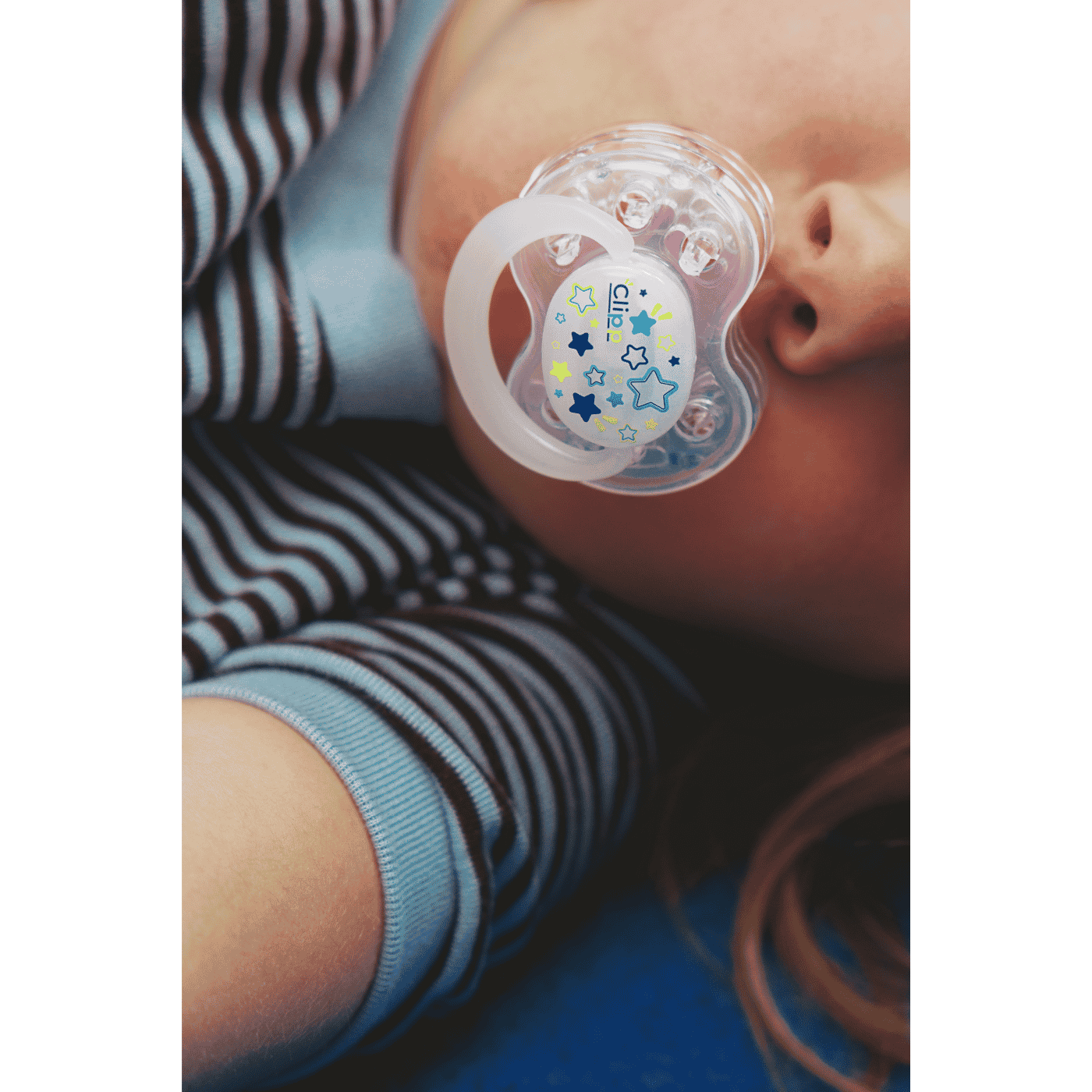
The impact on dental health
Sucking a dummy or thumb for a long time can affect how the teeth grow and fit together. Teeth can shift, creating alignment and bite problems (for example an open bite, where the front teeth no longer meet), sometimes requiring orthodontic treatment at a later date.
According to the British Orthodontic Society, what matters most is how long the habit lasts rather than how hard the child sucks, and effects on the teeth are more likely if it goes on for more than about 6 hours a day [1]. A common reference is to start limiting dummy use from around 6 to 12 months of age and to stop completely between 2 and 3 years old. The Society also notes that a dummy is easier to withdraw than a thumb if the habit continues (see thumb or dummy?) [1]. To understand these effects, see why remove the dummy.
The dummy habit
Sucking can become a habit that is hard to break if it goes on for too long. Children can become very attached to their dummy to calm down or fall asleep. This can make weaning harder and lead to frustration for both children and parents.
Possible effects on speech
Using a dummy or sucking a thumb for a long time can sometimes affect speech, because sucking can get in the way of the mouth movements needed to make sounds clearly. Some professionals also note that long-lasting sucking habits may, in some cases, affect jaw growth and functions such as breathing and swallowing.
To help limit these effects, it’s worth keeping an eye on dummy use and encouraging children to give up their dummy gradually. If in doubt, talk to your dentist, orthodontist, GP, health visitor or speech and language therapist.
Non-nutritive sucking is natural for babies, but it’s best to bring it to an end gradually. The British Orthodontic Society advises a positive approach rather than pressure [1].
Here are a few practical tips to help your child:
The Clipp weaning dummy can be a great ally in this big step: five “clip-on” shields are added one after another, gradually reducing the part available for sucking. Your child keeps their comfort item, with no abrupt removal. Weaning usually takes about 4 weeks*.
Clipp was also assessed in a pilot study at Nice University Hospital (dental surgery thesis, Université Côte d’Azur, 2025): among the 54 children who completed the follow-up, 51 stopped using their dummy (94.4%) [2]. Clipp has already supported more than 100,000 children and is recommended by more than 5,000 health professionals.
For more ideas, see how to wean a baby off its dummy.
* Every child is different, and weaning can take longer. In the pilot study, the average was 46 days (from 2 to 138 days) [2].
Sources :