
Tétine & Santé
18.05.2026
How do you choose between thumb sucking and a dummy for your child?

Choosing between a thumb and a dummy is an important decision for parents. These two ways of sucking can have different consequences for children’s development. While some families prefer the simplicity of a thumb, others opt for a dummy because it allows parents more control. We explain the advantages and disadvantages of each to help you make an informed choice that reflects your child’s needs.
Non-nutritive sucking is an innate reflex in infants. It helps babies feed by sucking at the breast or bottle, but sucking is not limited to feeding: it also plays an important role in soothing babies and helping them feel secure.
Babies often calm down, fall asleep more easily and feel secure when they suck. This need is particularly strong in the first few months of life, as it helps babies cope with stress and discomfort. As the child grows, the need usually diminishes, but the desire to suck may persist, which makes the choice between thumb and dummy worth thinking about.
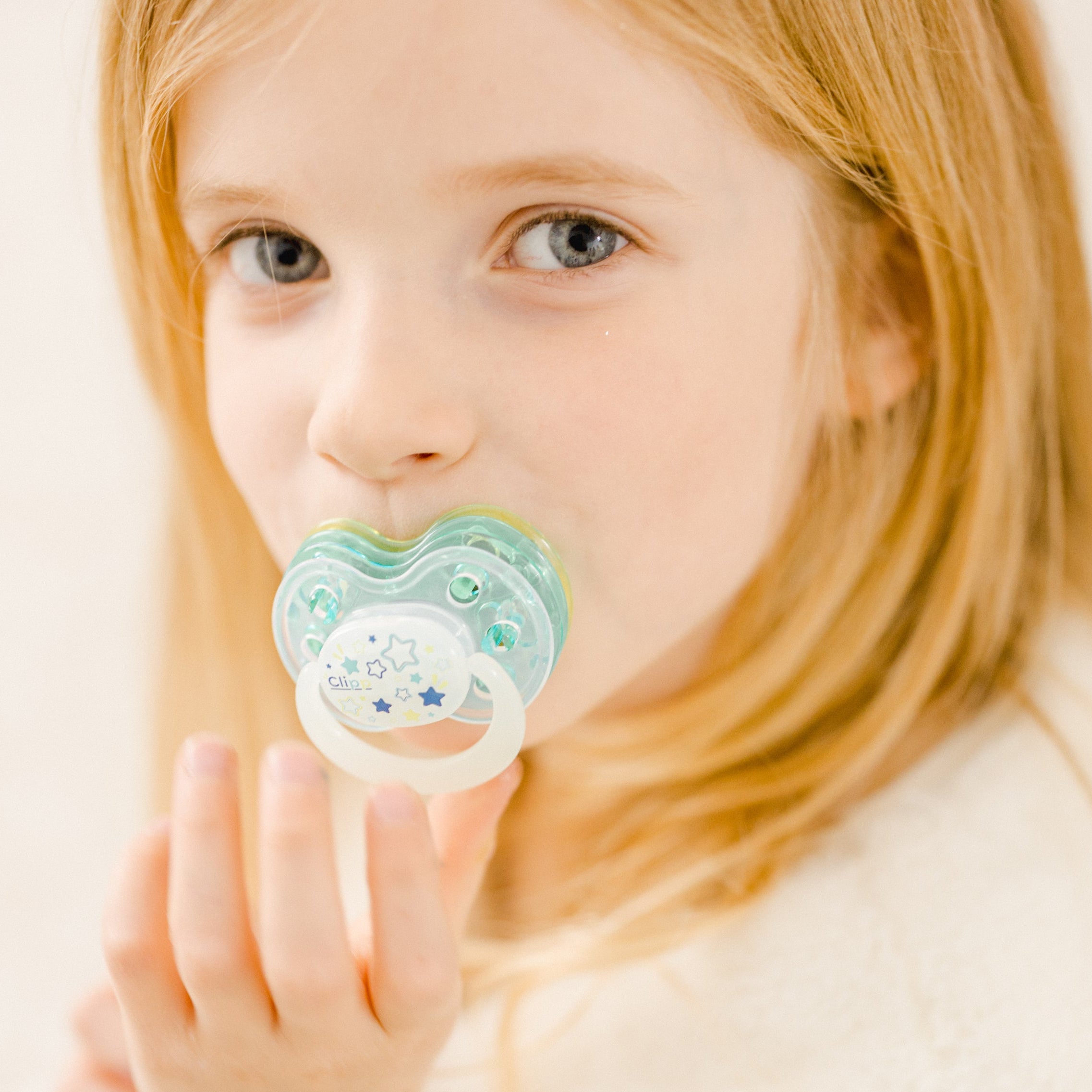
Thumb sucking
The thumb is always available, so the child can satisfy their need to suck at any time, without help. This independence can be reassuring for toddlers, especially when they are stressed or tired. The thumb also needs no purchase or upkeep, which makes it an economical option for parents.
But the biggest drawback comes directly from this advantage: a thumb can’t be lost, put away or limited, which can make weaning more difficult. As your child grows, the need to suck naturally diminishes, but the urge may remain, making it harder to stop.
According to the British Orthodontic Society, thumb sucking tends to decline more slowly than dummy sucking and is more likely to continue into the permanent teeth [1].
Dummy
A dummy offers a number of advantages over a thumb: parents have more control, as they can give it to their child or take it away. This makes weaning easier, as it is possible to reduce dummy use gradually. The British Orthodontic Society notes that dummy sucking declines rapidly as children grow, and that a dummy is easier to withdraw than a thumb if the habit continues [1].
However, a dummy has drawbacks too. Children can become very attached to their dummy, which can make weaning harder and emotionally difficult. Using a dummy a lot may sometimes affect speech, as it can get in the way of exploring sounds and words with the mouth. A dummy can also disturb sleep if it falls out often during the night.

Opinions differ on thumb versus dummy. Some professionals prefer a dummy because of the control it gives parents, and because it is easier to withdraw. Others point to the simplicity of a thumb, which requires no purchase.
However, the advice is the same for both: don’t let the habit go on for too long. According to the British Orthodontic Society, what matters most is how long the habit lasts rather than how hard the child sucks, and effects on the teeth are more likely if it goes on for more than about 6 hours a day[1].
Prolonged sucking, whether of a thumb or a dummy, can lead to changes in how the teeth fit together. It is therefore worth keeping an eye on sucking, and talking to your dentist, GP or health visitor if you have any concerns.
The choice between thumb and dummy depends on a number of factors, including your child’s age, your family situation and preferences. Here are some things to bear in mind:
You'll soon notice which your baby prefers. If they can find their thumb easily, that’s fine! But if your baby cries often and constant breastfeeding isn’t a solution, you can try a dummy. They will show whether they want it or not, and there’s no harm in trying.
It’s also worth noting that a baby sucking on a dummy from time to time to soothe themselves, it doesn’t mean they won’t be able to breastfeed. This can happen with some babies, but it could also be a sign that the breastfeeding period is coming to an end. In all cases, don’t hesitate to speak to your midwife, health visiter or an infant feeding specialist, who can advise you. And above all, listen to your baby: they know best what suits them.
For some babies, the question doesn’t even arise because they simply need to suck less. They soothe themselves in other ways and have no need for a thumb or a dummy… which settles the issue of weaning.
Whether it’s a dummy or a thumb, the aim is the same. A common reference is to start limiting use from around 6 to 12 months of age, and to stop completely between 2 and 3 years old. For more on timing, see when to stop the dummy.
If you feel it’s time for your child to stop using a dummy, it helps to talk about it with them. Try not to take the dummy away suddenly, without explanation. Some professionals also warn that stopping a dummy too early, or by force, can push a child towards thumb sucking, which is often harder to stop. Tell them they’re growing up and that, even though it may be hard at first, you believe in them and you’ll get through it together.
The British Orthodontic Society advises staying positive, avoiding nagging, teasing or punishing, and using a wall chart with a daily reward system [1]. The Dummy Weaning Toolkit can help, and you’ll find more ideas in how to stop your child’s dummy use gently.
You can also use the Clipp weaning dummy to help you get through this stage gently!
Discover our different models!
Source :